
Known for its once-in-a-lifetime trekking adventures up-close the mountain gorillas and chimpanzee, Uganda is a home to over 19 diurnal and nocturnal primate species. This diversity of primate species is due to Uganda’s geographic location at the confluence of Africa’s biggest biome or habitats. In Uganda, the vast East Africa savanna gives way to the West and Central Africa Forests, characterized by lowland, montane and tropical rainforest varieties.
Primates of Uganda
-
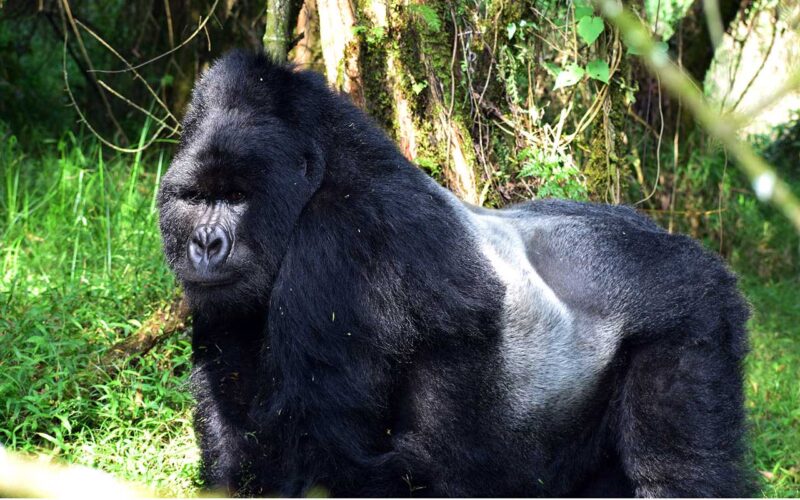
Mountain Gorillas
The largest of living apes, mountain gorillas are large and bulky apes restricted to montane and tropical rainforests in Uganda’s Albertine Rift. Mountain gorillas (Gorilla. b. berengei) are distinguishable with longer, thicker fur allowing them to thrive in higher altitudes. They are highly sociable, living in family groups led by a dominant adult male known as a Silverback, with several female and young. Mountain gorillas are largely herbivorous, eating a variety of shoots and bark.
Uganda protects over half of the global population of the endangered mountain gorillas in two pristine forests of Bwindi Impenetrable Forest and Maghinga Gorilla National Park.
Mountain gorillas trekking experience in a major highlight while visiting Uganda and is offered in two options of; the Ordinary and Habituation Mountain Gorilla Trekking Experience. These in-demand trek experience options differ in duration (time) one spends with gorillas, quality of experience and permit cost.
-
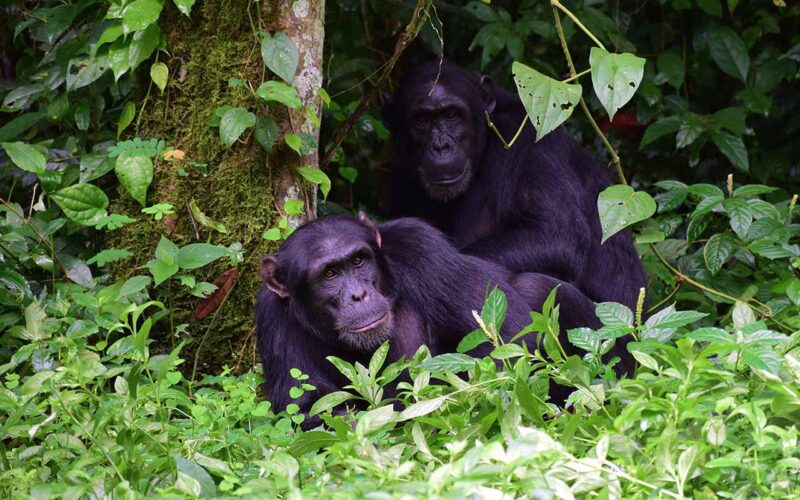
Eastern Chimpanzee
With up 98.7% of human DNA, the chimpanzee is more closely related to human than to any living primate. The chimpanzee is highly intelligent ape, living in large complex social communities comprising of multi-male associations, female and young groups. Chimpanzee’s innovative mastery of tool manipulation, problem solving capabilities and emotional display, highlight a great dimension of human-like intelligence and social behavior!
Chimpanzee is a highly vocal ape whose “pant-hoot” and a series of shrieks can be heard from a distance of up to 1.5km. Uganda is a home to over 5000 Eastern chimpanzees (Pan.t. schweinfurthi) scattered across a variety of habitats from montane forests, tropical rainforests, low-land forests and savanna woodlands.
Chimpanzee trekking experience is a major highlight on a Uganda safari and is offered in two options namely; Ordinary and Habituation options which differ in cost and time spent with chimps. Trek expereince is offered at Kibale Forest, Budongo, Kalinzu Forest, Kyambura Gorge and Ngamba Island near Entebbe.
Taxonomy Note: The Eastern Chimpanzee (Pan.t. schweinfurthi) is sometimes treated by some authorities as a subspecies of the Common chimpanzee (Pan troglodytes) that occur across various western Africa lowland forests.
-
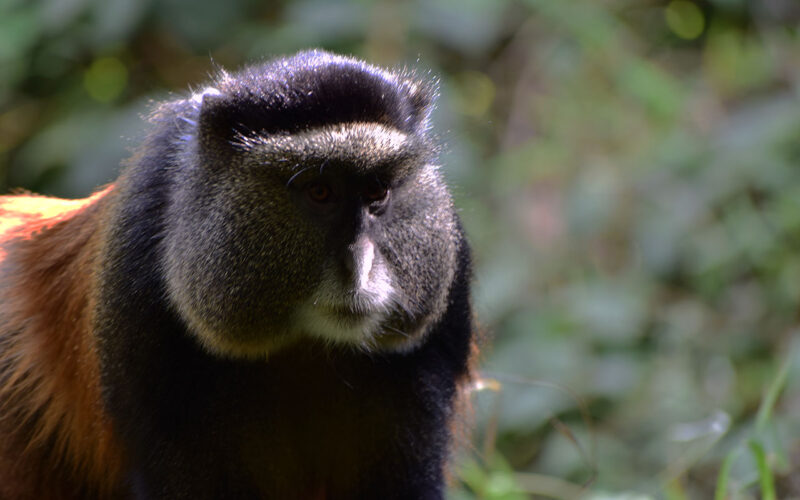
The Golden monkey
Distinctive with a grizzled golden back and cheeks, dark hands and legs, the golden monkey (Cercopithecus.m. kandti) is endemic to the Albertine Rift which cover Uganda’s Mgahinga Gorilla NP. The golden monkey is a bamboo specialist which makes over 80% of its diet. Social and highly mobile, the golden monkey lives in large troops numbering over 100 individuals with a dominant male at the helm.
Golden monkey trek experience is offered at Mgahinga Gorilla NP, where two large communities are habituated for daily treks.
-
L’hoest Monkey
L’hoest Monkey also known as Mountain Monkey is endemic to the Albertine Rift Mountain ranges and distinguishable with its overall dark coat and white bib. They live in fairly small groups with a single dominant male with related female and youngsters. Lhoest’s monkey is mostly a terrestrial primate, only taking shelter to trees when alarmed. L’hoest Monkey is best seen in Bwindi Impenetrable Forest and Kibale National Park.
-
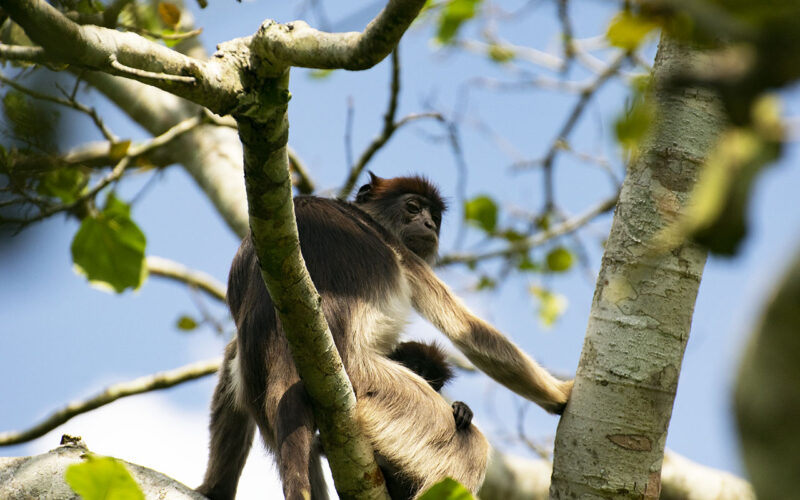
Uganda red Colobus
Distinctive with rusty-red cap, dark grey face hands and back, the Uganda red Colobus (Piliocolobus tephrosceles) is a beautiful primate that occur in isolated populations in Uganda. Uganda red colobus is a social primate, living in fluid multi-male groups from 5 to 30 individuals. The group numbers differ locally due to food availability and the size of their territory.
Uganda red colobus is listed by IUCN as endangered with large populations occurring in Kibale Forest National Park and Bigodi Wetlands.
-
Semliki Red Cobus
Semliki red colobus (Piliocolobus semlikiensis) is distinguishable with bright red fur on the crown, black hairless face and brick-red fore arms. In Uganda, the Semliki red colobus is only known from the vast lowland forests of Semuliki National Park which form its eastern range limit. Across its limited range, the Semliki red colobus favors hardwood forest and flooded palm forest.
-
Uganda Mangabey
The Uganda managabey (Lophocebus albigena ugandae) are arboreal and vocal primates with large populations known from Mabira Forest located 50-km east of Kampala the capital. Other smaller populations occur in Kibale Forest and Sango Bay. Uganda Mangabey trekking experience is only offered at Mabira Forest where a large troop is habituated for tourism.
Various authorities list Uganda mangabey as distant subspecies of the widespread Grey-cheeked Mangabey (Lophocebus albigena).
-
Grey Cheeked Mangabey
The Grey-cheeked Mangabey (Lophocebus albigena) is distinguishable with naked black face, long pale fur on shoulders and long ragged tail. They are a highly social monkeys often found feeding in associations. The male’s far-carrying and distinctive “whoop gobble” announces the presence of these characterful primates. Grey cheeked mangabey is found in Budongo Forest, Kibale Forest, Imaramagambo, Mpanga Forest and more.
-
Common Patas Monkey
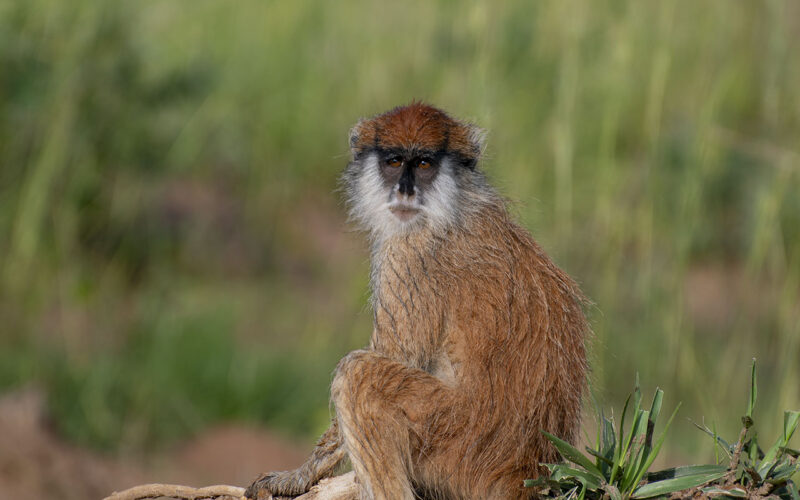
Equipped with slender build, aided by long legs and limbs, the Patas Monkey (Erythrocebus patas) is an open grassland, savanna and woodland specialist. The Patas Monkey occur in Murchison Falls NP, Kidepo Valley NP and other smaller reserves, where small to large troops forage. Patas monkey live in single-male, multi-female troops, with group size variable to food availability and season.
Female Patas Monkey are well camouflaged with the color of grass with shades of fawn but larger males have russet tails and crowns. Equipped with excellent eye sight and top speed of over 55km/hr, the Patas Monkey is well adapted for the open country and savanna woodlands. On the savannas, the Patas Monkey mainly feed on insects, gum seeds and tubers whereas its predators include, Martial Eagle, Jackal and Leopard.
-
Guereza Monkey
Guereza Monkey is a distinguishable black and white colobine that occur along both forest and woodlands edges in Uganda. The Guerezza monkey (Colobus guereza) belong to Colobus family that derive its name from their lack of a thumb, a unique adaptation to the species’ arboreal lifestyle. Guereza Monkey is also known as Mantled Guereza or simply Black and White Colobus Monkey.
While on a safari in Uganda, Guerezza Monkey is encountered in Kibale Forest, Bigodi wetland, Bwindi Impenetrable Forest, Kalinzu Forest, Budongo Forest and more.
-
Olive Baboon
The Olive baboon (Papio Anubis) is the most common primate in Uganda, occurring in almost all habitats except the higher altitude montane. Large with grizzled, olive-brown coloration, Olive baboon range from savanna grasslands, wetlands, lowland forests, rocky outcrops, along tropical rainforest edges and closer to human settlements. The success of Olive baboon across its range is attributed to the species’ “omnivorous opportunist diet” in the midst of fast changing habitats.
The olive baboon is highly social primate occurring in multi-male groups with a strict hierarchy and alliances within the troop.
-
De Brazza Monkey
Extremely shy, De Brazza Monkey (Cercopithecus negelectus) occur in selected swamp forests and riverine habitats in Uganda. They occur in small family groups, and are distinguishable from other guenons by their large size, orange crescent on the forehead and white beard. De Brazza Monkey can be encountered primarily in Mount Elgon National Park and Semuliki National Park.
-
Blue Monkey
Often called the gentle monkey, the Blue Monkey is a large, long-tailed, arboreal primate, that occurs in a wide range of forested habitats across Uganda. The Blue Monkey belong to a larger and taxonomically complex group, with numerous subspecies, hybrids and races across its native range.
The Uganda blue monkey cluster is the Stulman’s Blue Monkey (Cercopithecus (m) stuhlmanni) found in Echuya Forest, Bwindi Impenetrable NP, Kibale Forest, Rwenzori Mountains, Budongo Forest, Mt. Elgon and more.
-
Red-tailed Monkey
Deriving its name from long reddish tail, the Red-tailed Monkey (Cercopithecus. a. schmidti) is the most widespread small guenon across Uganda’s tropical forest. Highly social and active, Red-tailed monkey have white cheeks against blue faces and black and brown washed gray upper parts. Feeding troops keep in contact through a wide range of vocalizations including chirps and piercing alarm calls.
-
Vervet Monkey
Common at the woodland, marsh and forest edges the Vervet Monkey is another widespread species across Uganda. Distinguishable with black-faces, greenish-olive body, Vervet Monkeys occur in large troops of over 30 individuals with a dominant male at the helm. On the forest edges and near human settlements Vervet monkey are viewed as pests falling to poisoning and traps.
The Vervet Monkey group is now split into various full-species where the Uganda population is; Tantalus Monkey (Chlorocebus tantalus).
Nocturnal Primates in Uganda
Owing to their exclusive and secluded lifestyle, Uganda’s checklist of nocturnal primates is largely inconclusive and lacking proper documentation. The widespread nocturnal primates include,
- Galago or Bushbabies and Potto
Galagos (Galagidae) are most distinguishable with their piercing baby-like cries heard across numerous forests. In Uganda, the Greater (and the Senegal Galagos are the most widespread occurring in woodlands and savannas extending into riverine habitats.
Demidoff’s is common in various mid-altitude western forests whereas Spectacled Galgo prefers higher altitude and mountain forests notably on Rwenzori Mountains, Mgahinga Gorilla NP and Mt. Elgon National Park.
- Common Potto (Perodicticus p.ibeanus) is the known representative of Lorisids in Uganda.
Popular Primates tours in Uganda